
Grimbleton Hill The Shore

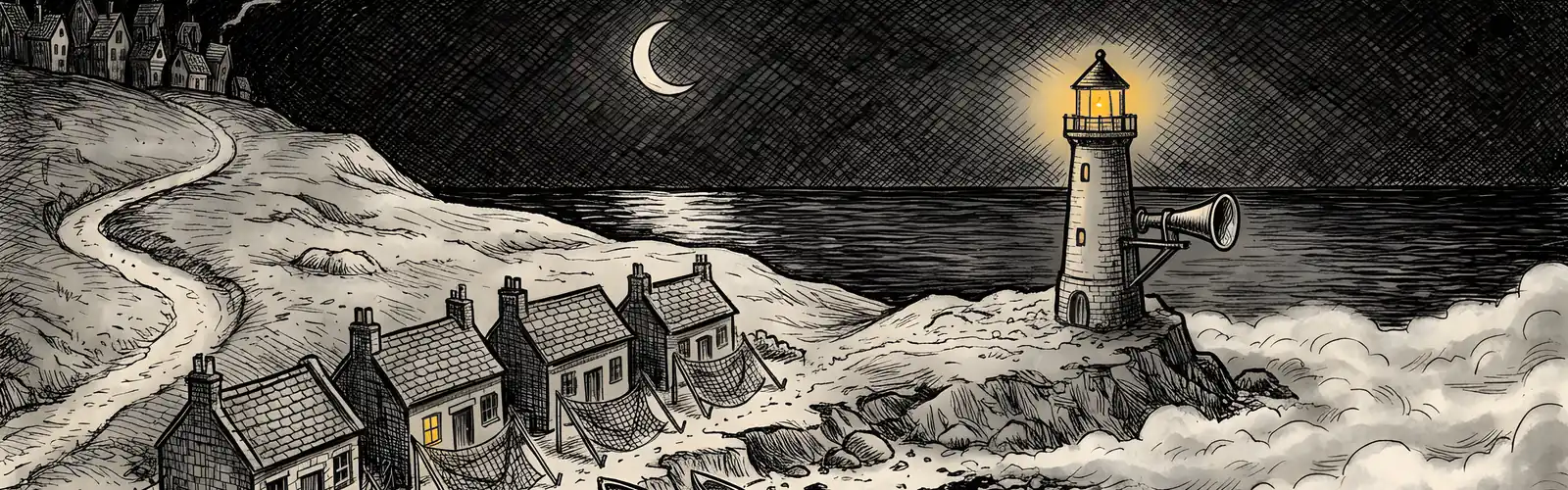
Most nights a fog comes in off the sea, and they come in with it, so nobody sees them arrive.






- The Lighthouse and Foghorn
- The Fog Bank
- The Fishermen's Cottages
- The Washing Line
- The Beach and Boats
- Path to Mildew
Morning sign
Sheets that are damp and smell a little of seaweed.
Custom
When the foghorn sounds, every one of them stops and stands still until it ends.
Home
The fishermen’s cottages, behind the nets.
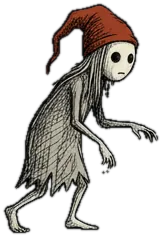
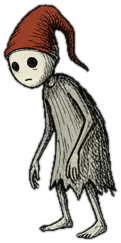
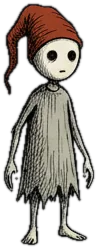
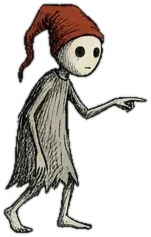
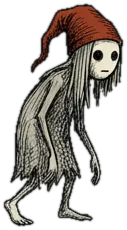
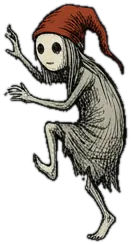
The Fog-Walkers of the Shore
Where They Live
In the fishermen’s cottages, behind the nets. A net is a fine place to hide if you are two inches tall and grey. Every hole in a net has a shadow to stand in.
In the bedroom they wait in the folds of the net by the window, in the gap between the bed and the wet wall, and in the sea chest at the foot of the bed, where the lid has never fitted. By day they sleep in a coil of rope in the porch.
What They Drink
Fog. They wring it out of the nets at dawn into acorn cups, with a pinch of salt from the windowsill. Nothing alive goes in.
There are no oaks on the shore. Acorns float, so the cups come in on the tide, a few each year. Few Fog-Walkers have a cup of their own.
A Night’s Work
- Arrive with the fog. It rolls in off the sea at dusk, and they come in with it, under the door and through the keyhole. A cottage may fill before the lamp is lit.
- Stand. When the foghorn sounds, they stop where they are and stay until it ends.
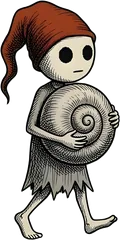
- Hang the seaweed. Each carries a strand of wet seaweed across his shoulders, like a muffler. At the bed they drape it over the foot rail, with the ends trailing into the sheets.
- Do the usual work from the Field Guide.
- Walk the bed. They go up and down it in rows, in bare wet feet, like a field being ploughed. No inch is missed.
- Leave with the fog as it thins, taking the seaweed. The last one tips his hat.
The morning sign is a bed that is damp all over and smells of seaweed.
Their Custom: The Standing
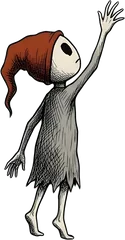
When the foghorn sounds, every Fog-Walker on the shore stops. This is called a Standing. They stop in mid-step, in mid-climb, in the middle of a knot, with one foot raised on the sleeper’s nose. The horn is the only sound a Murkmare is known to honour. They feel it in their bare feet, through the floor and the bed frame. They stand until it ends, and then a little longer, to be safe.
In a bad fog the horn goes every minute, and the work goes slowly.
Their Elders
The elders are the Old Hands, who have stood for more horns than anyone. The Eldest has counted every blast since the horn was built, and has never given the total.
The hats of the Old Hands are darkened with damp, and their tips hang heavy. In thick fog they walk at the front with their arms out, and the rest follow one hat-tip at a time.
How to Tell They’ve Been
The sign is damp sheets that smell a little of seaweed, in a cottage where the window was shut all night; they came in by the keyhole.
There are two smaller signs. The edge of your blanket clings, clammy as the underside of a boat. And a faint smell of seaweed stays in the pillow at lunchtime.
What the Grown-Ups There Say
“It’s the sea air,” or “the cottage is damp.” Every fishing household has a drying rack by the stove. The sheets go out in the sun and come in warm, and by next morning the damp is back.
One in the fog and two in the net,
Three on the stair, and the sheets get wet.
Four by the bed and five by the door,
Six in a row, and a dozen more.
Foghorn blows and they all stand still,
Seaweed sheets and a morning chill.
Sung while mending nets, a number for every knot, and then tucked into the lullaby for the youngest.
Did You Know?
A Fog-Walker in mid-Standing looks exactly like a coat peg. Fishermen’s cottages have more pegs by the door than coats.