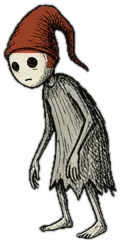
For grown-ups, after the children are in bed. These are papers gathered while the report was being written. The first section is real history: the old folklore of the mare. Everything after it comes from Mildew.

Long before anyone wrote down the Murkmares, there was the mare. In Germanic folklore the mare (Old English mære, Old Norse mara, German Mahr) was an evil spirit thought to sit on a sleeper’s chest, so that they woke with a feeling of being smothered. It gave its name to the nightmare.
It did not stop at people. Folk belief held that the mare also rode horses in the night, and farmers found them in the morning sweating, with their manes in tangles. Tangled hair was blamed on night spirits in more than one language: Danish has mare-lok, and English has elf-lock. In England, farmers hung a holed stone, a hag stone, above the stable door or round a horse’s neck to stop it being ridden.
Shakespeare knew the type. In Romeo and Juliet, Mercutio describes Queen Mab, “in shape no bigger than an agate stone”, whose tiny team drives “over men’s noses as they lie asleep”. She is the one that “plats the manes of horses in the night”, and she tangles sleepers’ hair into elflocks.
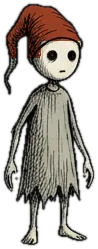
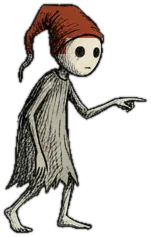
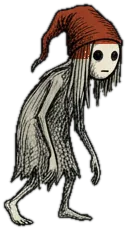
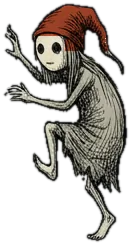
Small, busy at night, and fond of noses and knots. Whether the Murkmares learned their trade from the mare, or the mare from them, nobody in Mildew will say. The Wanderers pass through a great many farms.
Sources: Jacob Grimm, Teutonic Mythology, translated by J. S. Stallybrass; Pitt Rivers Museum, Oxford, “A Dorset hag stone” (1884.56.3); Shakespeare, Romeo and Juliet, Act 1, Scene 4 (Folger edition); Online Etymology Dictionary, “mare”.
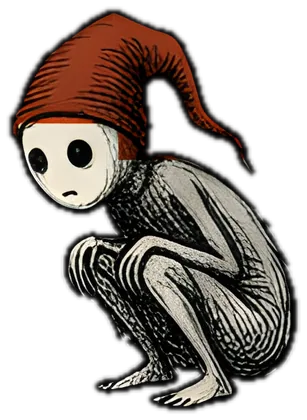

Kept at St Drowse’s, where the clerks changed and the complaints did not.
- 1797. The Widow Prain reports her pillow wet each morning, though she has not wept since 1791.
- 1803. The Curate complains that his collar is crumpled every Sunday, though pressed every Saturday. The laundress is blamed. The laundress is not to blame.
- 1811. The Sock Tax first noted: one sock from every house, every week. The vestry votes to object. The vestry’s socks are taken first.
- 1822. Pegs fitted to the noses of the Sunday school, eleven children, by way of experiment. No improvement. Several complaints from parents.
- 1838. The sexton sat up all night with a lamp to watch his son sleep. He reports that he blinked once, near three o’clock, and that it was enough.
- 1851. Census of Mildew taken: four hundred and two souls. A second count, of hats, was begun at the vicarage and given up before the first floor.
- 1874. New houses built at the top of the hill, true and square. By spring they leaned like the rest.
- 1902. Last entry in this hand. The clerk asks to be moved to a parish with fewer corners.

Every family in Mildew has tried something. None of it works, but some of it was written down.
- A holed stone over the bed, as the old farmers hung over the stable door. The Murkmares use its string as a ladder while they work.
- A bell tied to the blanket. They untuck the other side.
- A line of salt on the windowsill. They do not come in by the window. The salt goes in the pond-scum.
- A felt hat of one’s own, worn to bed. It was knotted to the bedpost by morning.
- A cat at the foot of the bed. The cat now sleeps in the kitchen and will not say why.
- Socks worn to bed, so there are none to take. The tax was collected anyway, one sock, from the foot it was on.
- Moving to the seaside. See the Fog-Walkers.
- Staying awake. See the sexton, 1838.

In a second hand, from 1903, after the first clerk was moved.
- 1903. The new clerk begins by counting the corners of the vestry. He finds one more than the builder’s plan, and reports it, and is told the plan is old.
- 1911. One hundred years of the Sock Tax. The vestry proposes no observance. It is collected regardless, one sock from every house, the vestry included.
- 1924. The Misses Goss, of Back Row, both complain of a taste on waking. Neither will describe it to the clerk. The elder Miss Goss asks that it be written down that it is not the cooking. It is written down.
- 1931. New iron beds for the vicarage, bought from outside the parish. A quiet month. Then the springs began to rust, and the month was over.
- 1947. A visiting archdeacon sleeps one night at the vicarage. He leaves before breakfast, wearing one sock, and does not stay for the second night.
- 1955. Electric light brought to every house on the hill. Each room is brighter. The corners are found to be darker than before, and there are no fewer of them.
- 1962. The schoolmistress asks the infants to draw what they think comes at night. She receives thirty-one drawings. All thirty-one are the same hat, drawn from the same side, at the same droop. None of the children had been shown one.
- 1988. The register is to be closed and sent to the county. It was sent. It came back in its parcel, unopened, with a note that the county holds no record of a parish called Mildew.

Collected by the second clerk, who tried most of them himself.
- A hammock slung from the beams, so that there is no foot of the bed to untuck. By morning one end had been let down by the width of a knot. The sleeper lay at a slant, toes out in the cold, with his hair plaited into the cord.
- A nightcap tied under the chin. The cap was found knotted into the hair beneath it, and the bow under the chin had been retied, more neatly.
- The morning’s clothes locked in a drawer, with the key under the pillow. The clothes were crumpled and folded again. The key was in the drawer.
- A ring of flour on the floor round the bed and the chair, to show which way they come. The flour was untouched in the morning. The clothes on the chair were crumpled. Nobody in the house has looked at the ceiling, and nobody will.
- A saucer of milk set by the wardrobe, as a gift. The milk was gone by morning, and so was the last drop in the jug, as usual. The work was done as usual. The saucer had been turned upside down, as when a guest has had enough.
- A sock left on the step on Sunday night, paid in advance. It was not taken. The tax was collected from the drawer as usual. The tax is not a fee.
- Husband and wife sleeping by turns, one to watch while the other slept. Both woke with knotted hair. Each says the other dozed. Both are right.
- The church bell rung at three, to wake the whole parish at once. The parish woke, and went back to sleep, and the work went on from where it had stopped. Nothing had been left out.

From the bound volumes, 1898 to 1904.
Sir,
I have sent my shirts to the same laundry for nineteen years. They come back pressed on a Friday. By Monday every collar is crumpled, though the shirts have not left the chair. The laundry denies it. I do not accuse the laundry. I should like to be told whom to accuse.
A. Pell, Back Row
Sir,
In reply to Mr. Pell. I have kept a book of this household’s socks since the spring. We lose one a week. It is never two, and it is never none. Whoever takes them can count, and I should like to know who taught them.
(Mrs.) E. Coyle, Church Steps
Sir,
Your correspondent of last week puts the leaning of our houses down to the clay. The surveyors will be glad of it. Perhaps he will also explain why they lean a little further in winter, when the nights are long, and come a little way back in June.
Ratepayer
Sir,
I am sixty-one. My wife and I have used the same pillow-slips since our wedding, and her side has always been wet in the morning. I had put it down to her. This winter it is my side. I do not wish to say more in a newspaper. I only ask whether others have found, at about my age, that it was their turn.
Name and address supplied
This correspondence is now closed, as it was in 1887 and in 1893. Ed.

Kept by the keeper, J. Haddon. Extracts, winter of 1891.
- 12 Nov.Fog off the sea at 10 p.m. Horn sounded at two-minute intervals, as regulation. Wife reports the sheets damp again this morning, and smelling of weed. The sea is a quarter mile off and well below us.
- 19 Nov.Fog. Horn as regulation. Sheets damp. Hung them by the stove all day. They dried, and still smelt of weed.
- 23 Nov.Fog at 9. I note that while the horn sounds the house is quite still, and between soundings it is not. I cannot say what I mean by this. Nothing moves that I can see.
- 2 Dec.Fog. Sounded the horn without a break from 1 a.m. till 4, against regulation, on the Board’s coal. Sheets dry this morning. Wife slept well. I did not sleep.
- 3 Dec.Board’s coal short. Will not repeat.
- 9 Dec.Fog. At 3 a.m. stopped the horn between soundings, to learn what the house did. Went down the stair with no lamp. The passage floor was wet in small patches, each the size of a thumbprint, running toward our room. Weed, very strong. In our room nothing moved. I stood in the doorway a long while, and so, I believe, did a great many other things. Went back up and sounded the horn as regulation, and did not come down again till it was light.
- 10 Dec.Board’s inspector to be told that the horn failed for eleven minutes at 3 a.m. It did not fail. Sheets damp.

Kept by Mrs. R. Lowe, below the hill. Harvest, 1926.
- 2 Aug.They have begun cutting at Marsh’s, two farms up the lane.
- 5 Aug.Marsh’s finished. Mrs. Marsh says they have all been sneezing at breakfast this fortnight, and this morning it stopped.
- 6 Aug.We began cutting.
- 7 Aug.Tom sneezed at breakfast, then the children, then me. Nobody sneezed at dinner, nor at supper. A fine yellow dust on all four pillows, laid in a line along the seam, very neat.
- 12 Aug.Sneezing at breakfast. The dust is not our wheat. Mr. Marsh came down to look and says it is his barley. His barley is in the barn.
- 19 Aug.Sneezing. The pillows smell of clover, of hay, and of something sweet. Tom says lavender. We grow none. Pell’s grew lavender, and cut it in June.
- 24 Aug.Moved the scarecrow to the top field, the bottom field being cut. In the morning, a ring of very small bare footprints in the dew round the empty post, a path of them up to the top field, and another ring.
- 28 Aug.Cutting finished.
- 29 Aug.No sneezing. The first quiet breakfast since the month began. The children asked where it had gone. Tom said Pell’s, and he was right, for Pell’s began cutting this morning.
- 3 Sept.Still quiet. I find I listen for it at breakfast, as you listen for a clock that has stopped.

1867. Money in the column, the rest in the margin.
- Mar. 4.To felling and splitting for the Vicarage, two loads. 12s 0d.Woke with the crease on my cheek again. Ash, by the look in the glass. I have cut no ash this year.
- Mar. 11.To a feather bolster, from the carrier. 4s 6d.Bought to stop the crease. Slept on it. The crease is now oak, and finer.
- Mar. 18.To nothing. Did not work.Have taken to sleeping flat on my back, so that no cheek is to the pillow. First night, a clear face. Second, clear. Seventh, clear. I am told at the inn that they will wait a week for one sleeper to turn over. I am told it as a joke.
- Mar. 26.To hurdles, twelve, for the glebe. 9s 0d.Ninth night. Turned over in my sleep at last. Beech, very deep, and it took until supper to fade. On the bolster, a crumb of moss, bright green, rolled round as if from the brim of something.
- Apr. 2.To felling the old beech at the head of the ride, by order. 15s 0d.That is the tree. I would know the pattern anywhere.
- Apr. 3.To mending the axe handle. 0s 4d.Beech again this morning, the same beech, and the beech is down. I have walked the ride twice and cannot find whose bark they use now. At dawn the stump was ringed with small bare prints, close together and pressed very deep, as if a great many had stood round it a long time.

Kept by the caretaker, Mr. F. Dunn. Spring term, 1934.
- Jan. 15.One sock, grey wool, child’s. Cloakroom. Not claimed.
- Jan. 22.One sock, black, darned at the heel. Under the infants’ pegs. Not claimed.
- Jan. 29.One sock, brown. A small square has been cut from the heel, very neatly, about the size of a thumbnail. Not claimed.
- Feb. 5.One sock. I note that every sock in the box is a left. I have set out a second box for rights, so that pairs may be made up. It is empty.
- Feb. 12.Box counted Friday afternoon: nine. Counted Monday morning, the school having been locked since Saturday dinner: eight. Lid shut. Nothing else missing.
- Feb. 19.Friday: nine. Monday: eight.
- Feb. 26.Friday: nine. Monday: eight.
- Mar. 5.Asked the Head whether a school counts as a house, for the purposes of the tax. She says it does not, since nobody sleeps here. I did not tell her that I sleep in the boiler room on Sunday nights, since my wife’s sister came to stay.
- Mar. 12.Friday: nine. Monday: eight. One of mine also, the left.

By Dr. H. Wren, Medical Officer to the parish. Read to the Sanitary Committee, 1888.
Gentlemen,
You asked me to account for the morning complaint in Mildew. Across the winter I visited one hundred and twelve households and examined every member of each at breakfast.
In children the signs are six, and they come in a fixed order: cold in the feet, matting of the hair, creasing of the clothes laid out for the day, a dry crust at the inner corner of each eye, a damp pillow, and an unpleasant taste, which no patient would describe to me. Adults show the same signs less often. Every household also reported the loss of one sock a week, which is not a medical matter, though it was raised with me more often than the rest.
My findings are these. Every sign is on the surface. I have found nothing in any patient that was not upon them, and nothing within. The signs are present on waking and gone by noon. The complaint is not contagious, and it does not pass from person to person. It keeps to the sleeper.
Three patients sent to relations outside the parish for a week reported no complaint while away. On the first night home it resumed in full. In the case of one boy, his mother reports that his clothes were crumpled, folded, and crumpled again, as though for the week he had missed.
I have no treatment to propose. I have not found the cause, though I have found a great many places where it is not.
The Committee asked whether I had suffered the complaint myself. I said that I had not. My housekeeper, who reads my papers, asks me to add that this is untrue.

From the catalogue of Crake & Daubney, Auctioneers, Mildew. Sale of household furniture, 14 March 1958.
LOT 47. An iron bedstead with brass finials, full size, mid-nineteenth century. With history.
Condition. Frame sound. Brass dull. The springs show no rust, which is unusual at this age, and are scored all over with very fine scratches, as though scraped a great deal by small tools. The underside of the frame has at some time been chalked with tally marks: four hundred and twelve, in groups of twelve, and several groups of thirteen.
Provenance. Sold by this house in 1879, 1903, 1912 and 1931. Each vendor described the bed as comfortable. None gave a reason for selling.
Sold with the contents of the space beneath, as found: forty-one acorn cups, empty, the rims stained green, and a quantity of grey fluff, rolled and pressed.
Viewing by daylight only. The purchaser is asked to collect before dusk on the day of sale. The auctioneers will not keep this lot on the premises overnight.
The vendor does not wish to be named, and does not wish it back.
Estimate £3 to £5. No reserve.

Small objects found in houses in Mildew, left to the parish by Miss E. Harrow in 1934 and kept in a glass case in the vestry of St Drowse’s. From the accession list.
- Acorn cup. Empty, the rim stained green. One of sixty-three. Each household that gave one says it was found in the morning, by the wardrobe, already empty.
- Needle, very fine, shorter than a fingernail, wound with grey thread. Found in the plait of a girl of seven, who had gone to bed with her hair loose.
- Felt, rust red, a small triangle with one edge torn, three-quarters of an inch long. Caught on a bed spring. Possibly the tip of something.
- A flea, in a twist of paper. Found at the bottom of an acorn cup. Labelled by Miss Harrow, “Left over.”
- Moss, in a ring, the inside about three-eighths of an inch across, as though it had grown round a brim. From a woodman’s cottage below Cutler’s Wood.
- Grey fluff, rolled into a pellet the size of a pea and pressed very hard. Not yet felt.
Miss Harrow’s note: no object in this collection was found by anyone who was awake when it arrived.
Note added 1951: the case was opened for cleaning, and every acorn cup in it was found to be damp. The case is not to be opened again.

In every murk there is a Last One. He waits at the back of the queue on your chin with his hat politely tipped, and when the others have finished he takes his turn. Then he tips it again, and that is how the others know the night’s work is over.
Whether it is the same Last One every night has never been settled. The only witness is asleep at the time.
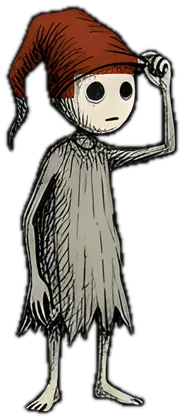

Children notice the Murkmares’ work. Somewhere around the age of eleven, they stop noticing, and the Murkmares carry on.
Grown-ups call it getting older: the morning breath, the pillow crease still on your face at lunchtime, the sneeze at breakfast, the sock you cannot find. The uncles, who have less hair to work with every year, make do.
Sleep tight.