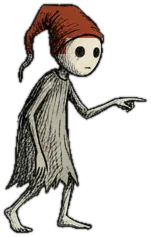
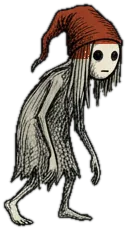
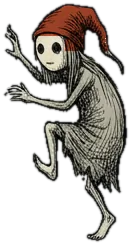
The Field Guide tells you how to spot the signs. This page is about the Murkmares themselves: what they are made of, how they live, and what they do all day. Most of it was learned by people who tried to stay awake. They do not recommend it.

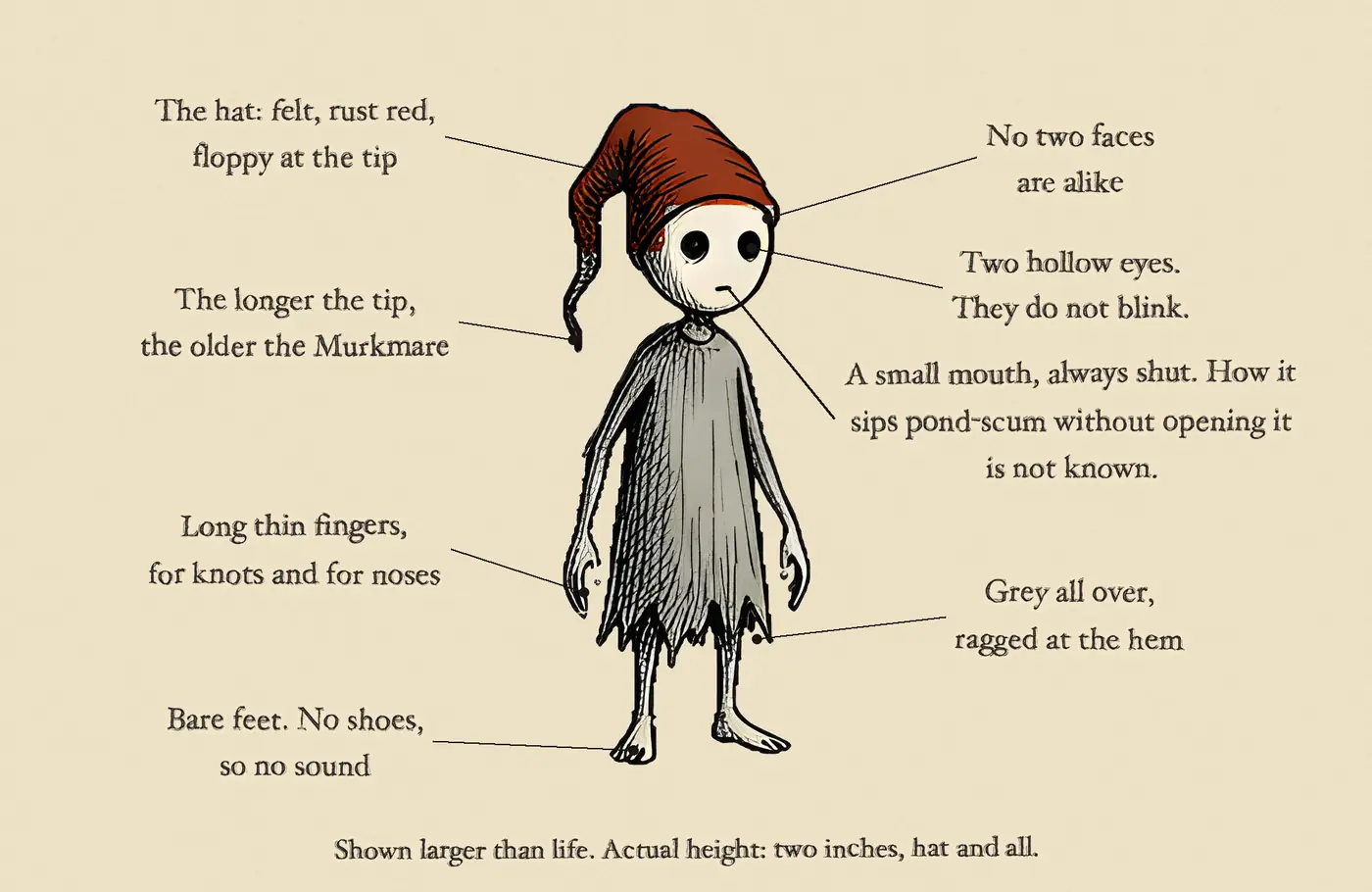
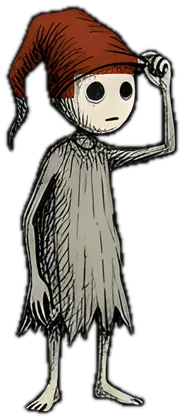
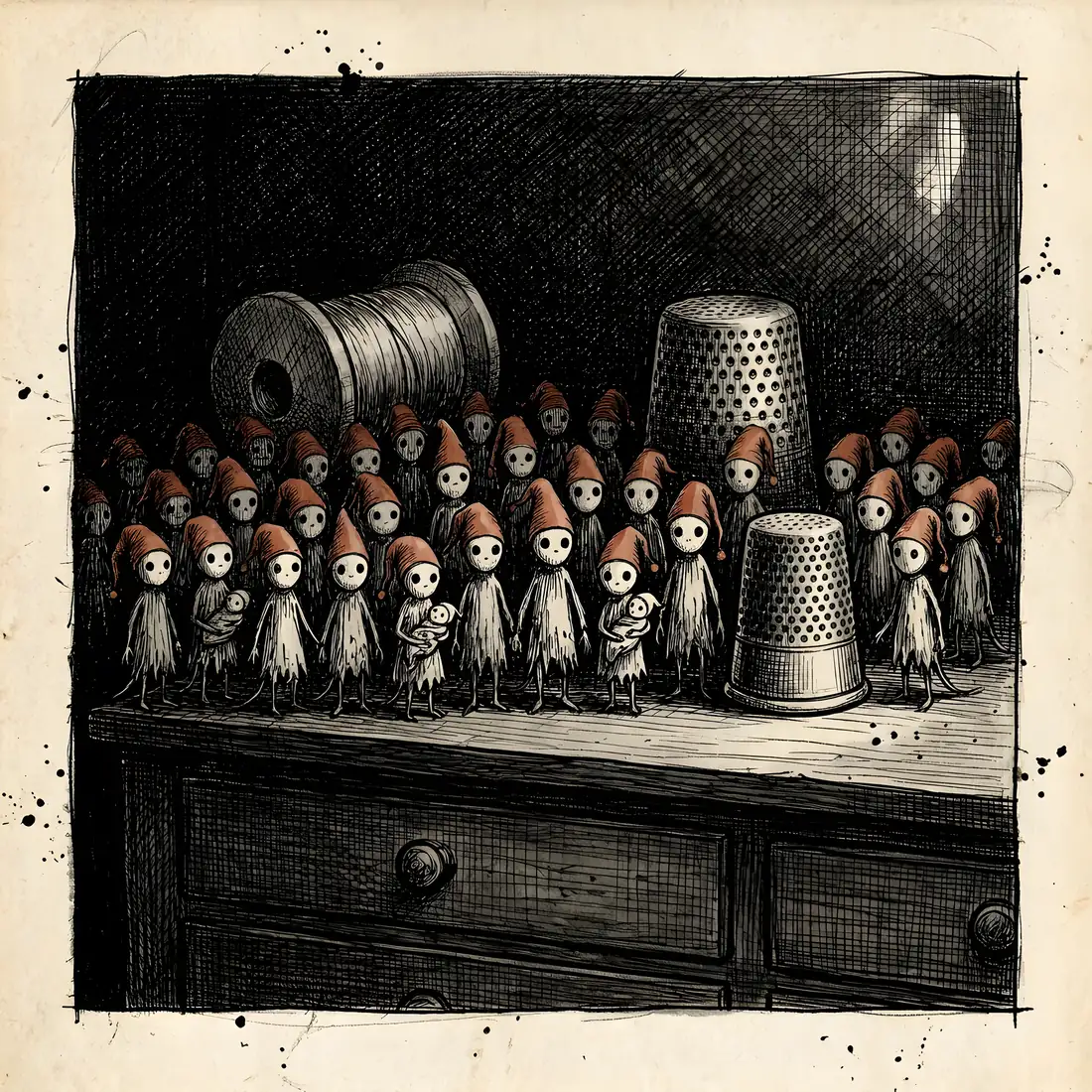
Here is one, drawn larger than life so you can see it properly. In your bedroom it would stand two inches tall, hat and all, and you would not see it at all.

Every Murkmare wears a pointed felt hat, rust red and floppy at the tip. It never comes off, except to be tipped.
The felt is made at night from the fluff under your bed, rolled and pressed until it holds. In Mildew they add the socks from the Sock Tax. The red comes from the rust on old bed springs, which is why a new bed has fewer Murkmares for a while, and why the while does not last.
A young Murkmare’s hat is short and stiff. Every year the tip grows a little longer and a little floppier, so you can tell a Murkmare’s age by how far its hat droops. The oldest have to hold the tip up when they climb. In the wood, where nobody hurries, some tips reach the ground.
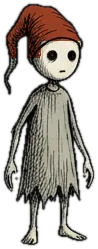
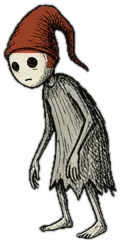
A family of Murkmares is called a murk. There is one murk to every sleeper, and it comes by the dozens: uncles and aunts, nephews and cousins, and somewhere near the back, the Last One.
The work is shared out by family. The aunts take the blankets, the uncles take the hair (it needs strong fingers) and the cousins see to the clothes. Everybody helps with the eyes. The youngest are sent to the pillow to learn to swim, and then they all queue for the last part.
Nobody has seen a Murkmare hatch, or be born, or arrive. One night there are a dozen. The next night there are thirteen, and the new one is already two inches tall and already wearing a hat.
For their first year the young are not trusted with knots. They paddle in the pillow pool, and they practise tipping their hats to each other, which is harder than it looks when the hat is stiff. Until it does something properly for the first time, a young Murkmare has no name at all. It is called Not Yet. See Names.

In Mildew, Murkmares live on pond-scum with milk and a flea. The pond-scum comes from the village pond. The milk is a drop from whatever jug was left out. The flea is for flavour. In the wood, the Slow Clan take dew from a toadstool, with a beetle.
They drink from acorn cups while they wait for you to fall asleep. A Murkmare has a small mouth and keeps it shut. How it sips anything without opening it is not known. The acorn cups are always empty by morning.

They have small mouths and never open them at work. A sound would wake you. Bare feet make no sound on floorboards.
They talk with their hats. One tip means the job is done. A slow droop of the tip means wait. Two quick tips mean the sleeper is stirring, and every Murkmare in the room goes still, wherever it is, until your breathing slows again. On the shore they go still for the foghorn too. Names are tipped as well. A name is a short pattern of tips, and a Murkmare is known by it for life.

By day, Murkmares sleep standing up in the dark corners of your room, with their hats pulled down over their eyes. They never blink, so they have to cover them. That is the only time a Murkmare’s eyes are covered, and it is never at night.

A Murkmare year follows the sleeper, not the calendar, and it turns four times.
Autumn is the lighting of the fires. The chimney becomes a way in again, warm for the first time since spring, and every murk comes down it on the same night.
Winter has two nights worth knowing. On the night of the first frost the aunts have almost nothing to do, because the cold does half the work and the blankets come away with one tug. On the longest night the murk has more dark than it will get all year, and it uses every minute. The queue at the chin moves slowly. The Last One waits at the back for a very long time.
Spring is for hats. On the first mild night each Murkmare’s felt is patched and pressed again, in place, by a cousin, because a hat never comes off. It takes a week and a great deal of fussing. The tip is let out by one thread’s width.
Summer has the windows open. Blankets are kicked off already, so the aunts sit in the shade of the chair with nothing to untuck. The nights are short and the work is hurried. The Murkmares do not use the window. The moths do.
A Murkmare has a mouth, but a name said aloud would wake the sleeper. So it is tipped.
A name is a pattern of hat tips. A long one and two short ones, say, or a droop and a flick. Nobody chooses it. A young Murkmare is called Not Yet, which is one slow tip with a small lean, until it does something properly for the first time. The first knot that holds. The first collar creased so well that the laundress is blamed. Whatever tip it gives in that moment, out of pride or surprise or relief, becomes its name, and the whole murk tips it back once to show it was seen.
That is why the names come out odd. One Murkmare in Mildew is Long, Flick, Droop. Another is Short, Short, Slip, after a night it would prefer not to discuss. A Murkmare who does something finer later in life may add a tip.
Nobody has written one down properly. The parish clerks tried, and put down Dip, Dip, Flop for the same Murkmare on three different nights. The Murkmares do not mind. They have never once mistaken one another for anybody else.

The young have the pillow pool, and they have other games too, all of them silent.
Statues. Somebody gives two quick tips and everyone freezes. The last to stop loses a turn at the pillow. It is the most serious game they play, because it is also the most useful.
Slow Springs. Bounce on a bed spring so gently that it makes no sound at all. The springs of Mildew are old and have opinions. A creak scores against you.
Thread Figures. Played with plaiting thread stretched across the long thin fingers. A good player can make the Wardrobe, the Bed and the Staircase. Nobody has made the Sleeper. It will not hold still.
Breath Guessing. Sit beside a sleeper and guess how many breaths before they turn over. The winner carries the thimble for a week, which sounds like a prize and is not.
Games end when the leader gives a slow droop. Nobody argues. There is nobody to argue with.

The murk keeps one kit, in the gap by the wardrobe, where the dust is deepest.
Acorn cups are for drinking and for bailing the pillow pool. Thimbles are buckets, and helmets, and when turned upside down, stools. Thread is pulled from the hem of whatever is hanging on the back of your door, and a strand from the old spider in the corner when the work needs it to be strong.
Pins are for prising up tucked blankets. A darning needle is longer than a Murkmare and is carried by two, one at each end, point to the back, like a ladder on the way to a fire. The one in front watches where it is going. The one behind watches the point.
There is one goose feather in the kit, for the tongue. It is the only tool with a waiting list.
Everything is lent and never given, and everything is back in the gap before it is light. If you find a thimble under your bed, leave it. Someone is coming back for it.

Every Murkmare has pockets in its small trousers, and everything in them is in order.
A length of thread, wound round a pin. A flat button, for no reason anyone has given. A scrap of rust felt for mending the tip. A flea on a string, kept for the pond-scum, still alive and wearing the look of someone who knows. Half a walnut shell with a small reserve in it, for the eyes, flap of the pocket down.
The hat carries one thing too. The floppy tip, folded back on itself, holds a single pin for emergencies and for the occasional quarrel.
No Murkmare carries a clock. They know how long until dawn the way you know how long until dinner. They carry nothing of yours, except a sock, once a week, in Mildew, and that takes twelve of them, six on a side.

Murkmares have rules, and they are stricter than yours.
They never go inside a sleeper. Not the mouth, not the nose, not the ears. A Murkmare leans and reaches and peers. It does not go in.
They never come twice in a night. When the Last One tips his hat the work is done, and not a Murkmare will touch the sleeper again until it is dark tomorrow, even if the pillow dries and the hair unknots itself.
They never visit a sleeper who is ill. A child with a fever, a cough or a bad stomach is left alone, and the murk waits in the shade of the chair until it passes. So if you wake up poorly, it is a cold, and it is nothing to do with them. Grown-ups will want to note this one.
They never carry on if the sleeper stirs. Two quick tips, and everyone stops.
They never take more than one sock a week from a house. The Sock Tax is very exact about this.
They will not say why they keep these rules. They do not say anything.
The leader of a murk is the one with the longest hat tip. The Slow Clan go by moss instead, and the mossiest hat leads, as the Field Guide says. Everywhere else it is the tip.
A leader does not give orders. It decides which gap the murk waits in, which nephew goes first up the foot of the bed, and when to give the slow droop that means wait. It goes first up the blanket, and it is never the last in the queue. That is a different office, and the Last One has never once swapped.
A leader’s tip gets long. A nephew is chosen to walk behind and carry it, so it does not drag in the dust. In the wood, where tips reach the ground, the Slow Clan need three.
When the tip is so long that the leader trips on it, the leader retires to the shade of the chair and becomes an Elder. Elders sit and watch. They give one very slow droop when they disagree, and the murk waits until the Elder has finished.
Votes are tipped. One tip for yes, a droop for no, counted by the youngest, who gets it wrong.

The Murkmares tell a story about the first of them. It is told in hat tips, takes most of a night and comes out a little different every time, so this is the usual version.
Before there were Murkmares there were corners. There was dust in the corners, and fluff in the dust, and the fluff had nothing to do. One night, in the first house with the first lamp, a child was tucked in and told to sleep tight, and the lamp was put out. The dark gathered in the gap by the wardrobe. The fluff pressed itself into a hat, to have something to wear. The dark stood up underneath it. That was the First Murkmare. It was two inches tall and already grey.
It found it had a small mouth. Then it looked at the child, who was sleeping with its own mouth wide open. The First Murkmare considered this for some time. One open mouth in a room, it decided, was plenty. It shut its own, and has kept it shut ever since.
It climbed the blanket. The rest is the order of work.
The Murkmares do not claim it is true. They tip the hat at the end either way.

Nobody knows, and the people who tried have not enjoyed it.
Start with what is certain. A murk comes by the dozens, and a small one is two dozen. There is one murk to every sleeper. In 1851 Mildew had four hundred and two souls. That makes at least nine thousand six hundred and forty-eight Murkmares, before cousins.
The count goes wrong at the cousins. A cousin who has been counted will slip round behind a nephew and be counted again, or stand behind two aunts and not be counted at all, which is worse. The vicar’s count of hats, begun that same year, was given up before the first floor.
Then there are the Wanderers, who are never in the same place two nights running and so come to a different total every time. Nobody has tried the wood. The Slow Clan would not hurry them, and the counter would have to wait a week for each one to roll over.
The grown-ups of Mildew have settled on a number. It is “enough”.

A Murkmare keeps no pets. It keeps arrangements.
The spider in the corner of the ceiling is the oldest tenant in the room. The murk leave its web alone, and the spider lets them borrow one strand a month when they need thread to be strong. No money changes hands. Both sides consider this fair.
Moths are the difficulty. A moth thinks a felt hat is the best dinner in the house. A Murkmare will stand perfectly still while a moth looks it over, and then another, and this is one reason they are so good at Statues.
The cat is the only creature in the house that can see them, and it has views. It does not chase. After one night spent watching the gap by the wardrobe for six hours, and being watched back by dozens of pairs of hollow eyes, the cat took its basket to the kitchen. It will not say why. The Murkmares stay off its side of the house and wait until it has left the room, which it does as soon as it can.
The flea is not a neighbour. It is an ingredient, and it knows.

Murkmares live in forests, near beaches, in towns, and in fields, and each place has made its own kind.
The rhyme every child on Grimbleton Hill knows.
Murkmare, Murkmare, grey and small,
Rust-red hat and they never call.
Dozens come when the lamps burn low,
Wake up knotted from head to toe.
Hush, my darling, there’s nothing there,
Nothing at all but the dark and the chair.
Sung at bedtime all over Mildew, last thing, just before the lamp is put out. The mothers think the last two lines are the joke.
-
The Slow Clan, in the wood.
The oldest and the most patient. They press bark to your cheek all night, and the mossiest hat leads.
-
The Fog-Walkers, on the shore.
They come in with the fog, so nobody sees them arrive, and they leave your sheets damp and smelling of seaweed.
-
Mildew’s own, on the hill.
The Murkmares in the book: they queue, they work two by two, and they collect the Sock Tax. Mildew has more Murkmares to the bedroom than anywhere else known, because leaning houses have more corners, and corners have things.
-
The Wanderers, in the fields.
They follow the harvest from farm to farm, dust your pillow with pollen, and tip their hats to the scarecrow on the way out.
The Slow Clan of the Wood
Where They Live
By day they live under tree roots, in the dark pockets where the soil has pulled back. By night they live wherever the sleeper is, and they get there along the roots. A woodcutter’s cottage has a tree close to the wall, and its roots have found the cellar by now. The Slow Clan come up through the cellar, up inside the wall, and out behind the log basket. From there they take the stairs one step a day.
In the bedroom they wait in the gap behind the headboard, in the knot-hole in the floorboard, and in the shade of the chair, made from a relative of the tree outside.
What They Drink
Dew from a toadstool, with a beetle. A toadstool holds a thimbleful at dawn. They carry it in acorn cups, one to each uncle, in a very long line at a very slow pace.
The beetle goes into every cup and is not drunk. He is a tradition. He has the look of a beetle who was told to wait and has not yet been told he can go. By nightfall the dew is often a little green, from the hats.
A Night’s Work
- Wait. A sleeper who rolls over sends them back to the start. A restless child may keep them waiting a week. They do not mind.
- Climb to the pillow, one handhold at a time.
- Do the usual work from the Field Guide, slowly. A Slow Clan knot takes four hours.
- Fetch the bark. Each uncle has carried a flake from his own root, flat under his hat. A dozen fit them together into a pad the size of a shirt button.
- Press. They set the pad on the sleeper’s cheek and lean on it, in turns, all night, so that the pressure never lets up.
- Tip. The last one tips his hat so slowly that the sun may be up before he finishes.
The morning sign is a cheek covered in creases.
Their Custom: The Leading
A Slow Clan hat is never taken off or brushed. Moss settles on the brim, and the moss decides the order. At dusk the murk stands in a row and compares hats. The mossiest goes to the front, and the rest fall in behind, in order of moss. Nobody votes.
A hat that dries out loses its moss, and its wearer moves back one place. Brushing is cheating. The leader goes first up every stair and picks the spot for the pad. No Slow Clan Murkmare has overtaken another in living memory, and in the wood that is a long time.
Their Elders
The mossiest hats belong to the oldest, so the Slow Clan are led by those least able to hurry. The Eldest has moss thick enough to hide the hat. What looks like a small green mound with legs is the head of the clan. The tips on elder hats are carried by nephews.
A Slow Clan tip takes a full minute. A conversation between two elders can last the winter. The younger ones do not wait for the end.
How to Tell They’ve Been
The sign is creases on your cheek, rough and criss-crossed like the bark of a tree, deep enough to read. They stay until lunch.
Two smaller signs belong to the same family. If you slept on your other side, the bark will have found your ear, which comes out ridged like a leaf. And a line may be pressed across your forehead, where the pad slipped.
Woodcutters’ families can tell from a cheek which tree the murk came from.
What the Grown-Ups There Say
“You slept on the seam.” In the wood it is always the seam of the pillowcase, or the lace edge, or a button. Nobody has found a seam shaped like an oak leaf, but they keep looking.
Slow, slow, the Slow Clan wait,
Mossy hats at the garden gate.
Lie still, lie still, don’t turn your head,
They’ll wait a week beside your bed.
Roll over once, and slow, slow, slow,
Bark on your cheek, and off they go.
Sung in the woodcutters’ cottages at the edge of the wood, to a child who will not stop rolling over.
Did You Know?
The Slow Clan have been seen to hurry once. A log fell near the cottage. They took until the following Tuesday to finish hurrying, and they were very tired.
The Fog-Walkers of the Shore
Where They Live
In the fishermen’s cottages, behind the nets. A net is a fine place to hide if you are two inches tall and grey, because it is mostly holes and every hole has a shadow.
In the bedroom they wait in the folds of the net by the window, in the gap between the bed and the wet wall, and in the sea chest at the foot of the bed, where the lid has never fitted. By day they sleep in a coil of rope in the porch.
What They Drink
Fog. They wring it out of the nets at dawn into acorn cups, with a pinch of salt from the windowsill. No beetle, no flea, no creature of any kind, which the other clans find suspicious.
There are no oaks on the shore. Acorns float, so the cups come in on the tide, a few each year. A Fog-Walker with a cup is a Fog-Walker who has been lucky.
A Night’s Work
- Arrive with the fog. It rolls in off the sea at dusk, and they come in with it, under the door and through the keyhole. A cottage may fill before the lamp is lit.
- Stand. When the foghorn sounds, they stop where they are and stay until it ends.
- Hang the weed. Each carries a strand of wet seaweed across his shoulders, like a muffler. At the bed they drape it over the foot rail, with the ends trailing into the sheets.
- Do the usual work from the Field Guide.
- Walk the bed. They go up and down it in rows, in bare wet feet, like a field being ploughed. No inch is missed.
- Leave with the fog as it thins, taking the weed. It is the one tidy thing they do. The last one tips his hat.
The morning sign is a bed that is damp all over and smells of seaweed.
Their Custom: The Standing
When the foghorn sounds, every Fog-Walker on the shore stops. This is not a pause. It is a Standing. They stop in mid-step, in mid-climb, in the middle of a knot, with one foot raised on the sleeper’s nose. The horn is the only sound a Murkmare is known to honour. They feel it in their bare feet, through the floor and the bed frame. They stand until it ends, and then a little longer, to be safe.
In a bad fog the horn goes every minute, and the work takes until Thursday.
Their Elders
The elders are the Old Hands, who have stood for more horns than anyone. The Eldest has counted every blast since the horn was built. Asked the total, she tips her hat to say that it is a large number and none of the young ones’ business.
The hats of the Old Hands are darkened with damp, and their tips hang heavy. In thick fog they walk at the front with their arms out, and the rest follow one hat-tip at a time.
How to Tell They’ve Been
The sign is damp sheets that smell a little of seaweed, in a cottage where the window was shut all night and the keyhole was not.
Two smaller signs belong to the same family. The edge of your blanket clings, clammy as the underside of a boat. And a faint smell of seaweed stays in the pillow at lunchtime. The giveaway is the window. The sheets are damp and the glass is dry.
What the Grown-Ups There Say
“It’s the sea air.” Or “the cottage is damp”, or “the fog gets into everything.” Every fishing household owns a drying rack, and nothing on it has ever dried. The sheets go out in the sun and come in warm, and by next morning the damp is back. In a way they are right. The weather is what the Fog-Walkers come in on.
One in the fog and two in the net,
Three on the stair, and the sheets get wet.
Four by the bed and five by the door,
Six in a row, and a dozen more.
Foghorn blows and they all stand still,
Seaweed sheets and a morning chill.
Sung while mending nets, a number for every knot, and then tucked into the lullaby for the youngest.
Did You Know?
A Fog-Walker in mid-Standing looks exactly like a coat peg. Fishermen’s cottages have more pegs by the door than coats. Nobody has counted them. Please do not.
Mildew’s Own
Where They Live
In the gaps between the leaning houses. The houses of Mildew lean on each other like tired men, and at the top the eaves almost touch. The Murkmares use the slot between them as a lane and cross from house to house above the street, two by two, at the height of the second floor.
In the bedroom they wait in the four usual places. They add the foot of the stairs, where the lamp is put out, and the gap behind the chimney breast, where the plaster is damp and the lean is worst.
What They Drink
Pond-scum with milk and a flea. The scum comes from the north bank of the village pond, where the ducks do not go. The milk comes from whichever jug was left out. The flea is chosen by the cousins. It is the only decision in Mildew that a cousin is trusted with, and they take it very seriously.
A Night’s Work
They queue in the gap by the wardrobe, two by two, in order of age. The work follows the Field Guide: toes, hair, clothes, eyes, pillow, chin. One night in seven is Tax Night, and on that night the murk adds one thing.
- Choose the night. It is a different night every week, so that nobody can prepare. This has never stopped anyone from trying.
- Find the sock. It may be in the drawer, on the chair or on the foot it was on, which the cold toes have conveniently left bare. They take one. A pair would be theft. One sock is a tax.
- Carry it out. Twelve Murkmares, six on a side, two by two, lug the sock down the stairs and out into the lane.
- Deliver it to the felt works, under the church, where the sock is unpicked and pressed into hat felt. Many a Mildew hat began as someone’s Sunday sock.
- Tip. One Murkmare tips his hat toward the house. This is called the Receipt. The house does not read it.
The morning sign, on Tax Night, is one sock missing.
Their Custom: The Queue
Everything in Mildew is done in a queue. They cross the floor in one, climb the bedclothes in one, and go to the tax in one. Nobody pushes. A cousin who has lost his place goes to the back and begins again. The system has never been questioned, because to question it you would have to leave the queue.
Their Elders
The elders are the Clerks, who keep the Tally. The Tally is a strip of felt with one stitch for every sock taken since 1811, when the vestry noticed. It is kept rolled up inside the tower wall at St Drowse’s. By now it has pushed against the bricks and is held responsible, by the Clerks, for about a third of the lean.
The Oldest Clerk stands at the front of every queue. He has never been last. The Last One has never been first. Each of them regards the other as the unfortunate one.
How to Tell They’ve Been
The sign is one sock missing. Never a pair, always one.
Two smaller signs belong to the same family. The sock that was left behind is folded in a neat square on the chair, and you did not fold it. And the sock drawer holds an odd number, whatever you did on Saturday. Hand-knitted socks go first. The Murkmares can tell by the bumps.
What the Grown-Ups There Say
“The wind took it off the line.” Or “the wash”, or “the dog”. Several houses in Mildew have no dog and blame him anyway. Every family keeps a drawer of odd socks, for when the others turn up. They never turn up. They are in the Tally.
Did You Know?
Nobody in Mildew gives socks as a present. It is thought pointless.
The Wanderers of the Fields
Where They Live
Wherever they were last night. They have no fixed home and would find one tiresome. By day they ride the harvest cart, down at the bottom of a sack of grain, or tucked in the hem of the scarecrow’s coat.
In a farmhouse bedroom they wait in the gap behind the door that never closes, under the sagging bed in the room over the kitchen, and in the shade of the chair, where the farmhands hang their coats. The coats are always dusty.
What They Drink
Whatever is nearest. Each Wanderer carries one acorn cup in his hat and fills it where he finds it: rain from a cart rut, a splash from the trough, a skim off the top of the milk pail. At the end of harvest there may be cider. He adds one stalk of whatever is growing, so that the cup tastes of that farm.
At the next farm the cup is emptied, rinsed, and the stalk thrown away. A Wanderer keeps no souvenirs. He keeps pollen, which is different.
A Night’s Work
- Arrive by cart. The harvest cart pulls into the yard at dusk, and they drop off the back wheel, one at a time, in a line.
- Load the hats. Each carries pollen in the crown of his hat. The top layer is from the last farm, and underneath is a little from the farm before.
- Do the usual work from the Field Guide, and do it quickly. A Wanderer has never slept under the same ceiling twice and has no patience for a long job.
- Dust the pillow. They tip their hats and shake out two pinches each, as a baker flours a board, thickest where the nose will be in the morning.
- Leave before light, in a line, by the field gate.
- Tip to the scarecrow. Then onto the next cart.
The morning sign is a sneeze at breakfast.
Their Custom: The Tipping Out
Out of every farm, the line passes the scarecrow, and every Wanderer tips his hat to it, once. It is the only thanks the Wanderers give a place. The scarecrow is the one who stood out all night and saw everything, and the one who has never told. The eldest goes first. The youngest goes last and has to run to catch up.
Their Elders
The elders are the Gleaners. They ride at the front of the cart and read the harvest the way other murks read hats: this farm has cut its wheat, that one has not. Their hats are dusty to the brim, and their tips are curled from a lifetime of tipping into wind.
A Gleaner has been to more farms than he can remember and has forgotten where the first one was. Asked where home is, he tips his hat toward the road.
How to Tell They’ve Been
The sign is sneezing at breakfast, three or four in a row, usually just as someone is passing the bread.
Two smaller signs belong to the same family. A sniff that comes and goes, and eyes that water over the porridge. And a faint yellow dust along the edge of your pillowcase, which comes off on a finger. The more farms behind the murk, the louder the sneeze.
What the Grown-Ups There Say
“It’s the hay.” Or “the dust from the threshing”, or “a draught from the barn.” In a farmhouse the harvest is blamed for everything, which for a few weeks of the year makes it right.
Wanderers, Wanderers, where do you sleep?
Wherever we were when the night got deep.
Wanderers, Wanderers, where do you go?
Wherever the wheat and the barley grow.
Pollen on the pillow, pollen on your head,
Atishoo, atishoo, over the bread.
Sung on the farms at harvest time, to a child who has been sneezing since lunch, and sung back, sneezes included.
Did You Know?
Every scarecrow on Grimbleton Hill has its hat tilted a little, as if it had tipped back. Nobody has seen it do this. Nobody has stayed up.
When Clans Meet
Clans are seldom in the same room. When they are, the rule is simple. Tip your hat in the other clan’s manner, and get on with your own work.
A Wanderer passing through Mildew is stopped at the gap and counted. If he stays the night he pays. A Wanderer’s sock is taken from the next house down the lane, in place of that house’s own that week, so no house ever loses two. The next house cannot say why.
Fog-Walkers sometimes drift up the hill on a thick evening, further than they have any business, and arrive in a Mildew lane with the fog still on them. They stand still. The Mildew murk has never been able to tell whether they are honouring the foghorn or are lost.
The Slow Clan are the hardest to host. A Mildew murk can finish three jobs and go home before a Slow Clan greeting is half done. It is best to leave a space in the queue and come back in a week.
When two clans share a bedroom, they divide the sleeper. The Slow Clan take the cheek, the Fog-Walkers the sheets, Mildew the socks and the Wanderers the pillow. The sleeper wakes with bark creases, damp sheets, one sock gone and a sneeze. The children call it a bad night. The grown-ups call it the weather.
See where they go in The Maps. Grown-ups: The Archive.